Showing posts with label stainless. Show all posts

Wednesday, November 01, 2006

Dos and Don'ts of Cleaning Your Stainless Steel Sink

  • Do...It is best to rinse stainless sinks thoroughly after each use. Thorough rinsing can be done by running the water for a few minutes and rubbing the cleaned area with a sponge.
  • Do...Avoid exposing stainless sink to strong chemicals, such as paint removers, oven cleaners, etc. If contact occurs, quickly flush the surface with water.
  • Do...Run cold water when pouring boiling water into sinks to try to minimize temperature shock. With stainless it isn't as important to remember that compared to other materials though.
  • Do...Towel dry after each use to prevent mineral deposits from building up on the surface of the sink (although with a good quality stainless sink you can buff it back to the original "new" finish even after many years of scale and mineral build-up.
  • Do...Scour the sink once a week, being sure to rub in the direction of the satin finish lines (best not to purchase a "mirror" finish).
  • Do...Remove nail polish with a non-acetone based nail polish remover and flush with water.

  • Don't...Allow food or beverage residue, or metal canned products to remain on sink surface.
  • Don't...Cut directly on sink surfaces.
  • Don't...Set hot pans directly into sinks.
  • Don't...Scour the sink across the satin finish lines. Scouring across the satin finish lines can damage the original sink finish.
  • Don't...Allow liquid soap or other household cleansers to dry on the surface of the sink. Most brands contain chemical additives, which will affect the finish.
  • Don't...Leave standing solutions of chlorine bleach and water in the sink for extended periods of time. Chlorides, which are found in most soaps, detergents, bleaches, and cleansers, are very aggressive to stainless steel. If left on the sink too long they can cause surface pitting.
  • Don't...Use a steel wool pad to clean your sink. Steel wool pads have a tendency to break apart and small particles of steel can become embedded in the surface of the sink. The steel particles will rust and will give the appearance that the sink itself is rusting.
  • Don't...Use rubber mats or dishpans in the sink to protect the finish. Leaving rubber mats or dishpans in the sink can lead to surface rust or possible pitting. However, if you do use mats or dishpans please remove them after each use.
  • Don't...Leave wet sponges, cloths, or cleaning pads on the sink. This can lead to surface rust.

Article Source: Plumbing World

Thursday, October 26, 2006

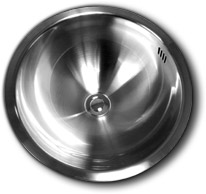
Stainless Steel Bath Sinks

Stainless steel sinks are not just for the kitchen anymore.

Some renovators are using this cool gray metal to bring a rustic, industrial design to the bathroom.

Who's Buying Them?
The trend is catching on in urban areas, where loft buildings create the perfect backdrop for this industrial metal. Others want a unique, cutting edge look for a high end contemporary home.

How to Blend It
Put a stone texture solid surface countertop underneath as a way to add contrast between a natural look material and a shiny metal bowl.

Why Stainless?
Stainless steel is considered very durable and easy to maintain, features that make it easy to adapt to the kitchen and bathroom. "Stainless has been a versatile material -- it doesn't chip, it doesn't stain," said Bruce Keclik, director of product development for Just Manufacturing, a sink, faucet and accessories manufacturer in Franklin Park, IL.

The shiny metal also reflects light. Since there typically is lighting over the sink, the metal will add a subtle sparkle to the room when the lighting is on.

"It's a different look for people," Keclik said. "I think the colors have somewhat run their course in the home and people are looking for something different."

How to Design with Stainless?
Those who are considering stainless should realize that it is a unique look and one that fits a contemporary design. While it can be blended into more traditional designs, the look has the clean lines that characterize contemporary.

Begin by deciding just how much stainless you want. Consider:
  • A countertop for one sink or two?
  • An all stainless countertop and sink?
  • A wood, stone, solid surface or laminate countertop with a stainless sink?
  • A polished or brushed stainless sink? Or, a combination of the two?
  • A his and her setting -- two separate single bowls placed in separate sections of the bathroom?

Other Tips
When using stainless for the counter and sink, make sure the two pieces are made of the same gauge of stainless steel. Otherwise, the sink and countertop may look different when placed next to each other, said Jim Brunetti, owner of Avenue Metal Manufacturing in Chicago, which makes custom sinks, countertops, walls and other products.

This design can be achieved by dropping a sink into a countertop opening or by having the two pieces welded together.

Article Source: Renovators Place

Friday, October 06, 2006

Benefits of Stainless Sink


Stainless steel has emerged as the most popular choice of materials for new sink installations because of its low cost, light weight, and almost unbreakable construction. Stainless steel sinks are made in many sizes and several thicknesses, measured in gauge.

The gauge of the stainless steel is the thickness of the stainless steel sink. The most common gauges are 18 and 20. The higher the number gauge, the thinner the steel. Eighteen is the most recommended gauge for sinks.

Stainless steel kitchen sinks are easy to clean and will stay looking newer for longer when cared for properly. You won’t have to worry about leaving lemons in the sink overnight or cranberry stains, but it can become dull and scratched. It is best to put a plastic or rubber mat in the sink to protect it from scratches. A mat will protect the shiny surface and keep it looking new longer.

When choosing a kitchen sink, there are many different decisions that need to be made. Even the simplest of sinks are available in different styles and colors. The first consideration is the size. Make sure that your sink fits.

Sinks are made with various qualities of stainless steel. Light-gauge stainless steel is more vulnerable to denting and scratching.

Stainless steel is also available in a mirrored finish, which gives it a shinier appearance. In brushed-stainless finishes, which is the latest trend, scratches are less visible.

Kitchen sinks come in one bowl, two bowl, or three bowl models. The bowls can be deep or shallow. Single bowl sinks are basic, and their depth can vary from 10” to 12”. Two and three bowl sinks allow for multi-tasking. For example, you can rinse or store dishes in the large bowl, and use the small bowl for a garbage disposal or to rinse vegetables.

Article Source: Jason Gluckman